



A plain comparison of the three ways Australian businesses control physical keys, what each one actually records, and where each one stops being enough.
The new starters list lands on Monday morning. The facilities coordinator adds three names to the key register in Biro, hands over three sets of keys and gets on with the day. Nobody notes which set went to whom. The page only has room for a name and a signature, and half the signatures are illegible anyway.
Six weeks later, a night-shift contractor turns up holding a master key. The register says it went to someone who finished up a month ago, and nobody can explain how it changed hands or which doors it has opened since.
Gaps like that are what auditors and insurers ask about, and how someone ends up being asked for a recommendation. If you need the background first, start with what a key management system is. This guide works through the electronic key cabinet vs key safe decision, with the manual key register alongside, so you can pick a category and explain the choice to whoever signs it off.
TL;DR: A key safe is a small locked box that holds one to a handful of keys and records nothing. A manual key register is a logbook or spreadsheet that records key movements on trust, in handwriting, after the fact. An electronic key cabinet is a networked cabinet that issues keys against a named user and logs every removal and return automatically. Choose a key safe for a handful of low-risk keys with no reporting need, a register only where nothing sensitive is involved, and an electronic cabinet once you need to prove who had which key, control contractor access, or answer an auditor.
For transparency: KeyWatcher Australia sells key management systems and published this comparison. It covers categories, not brands.
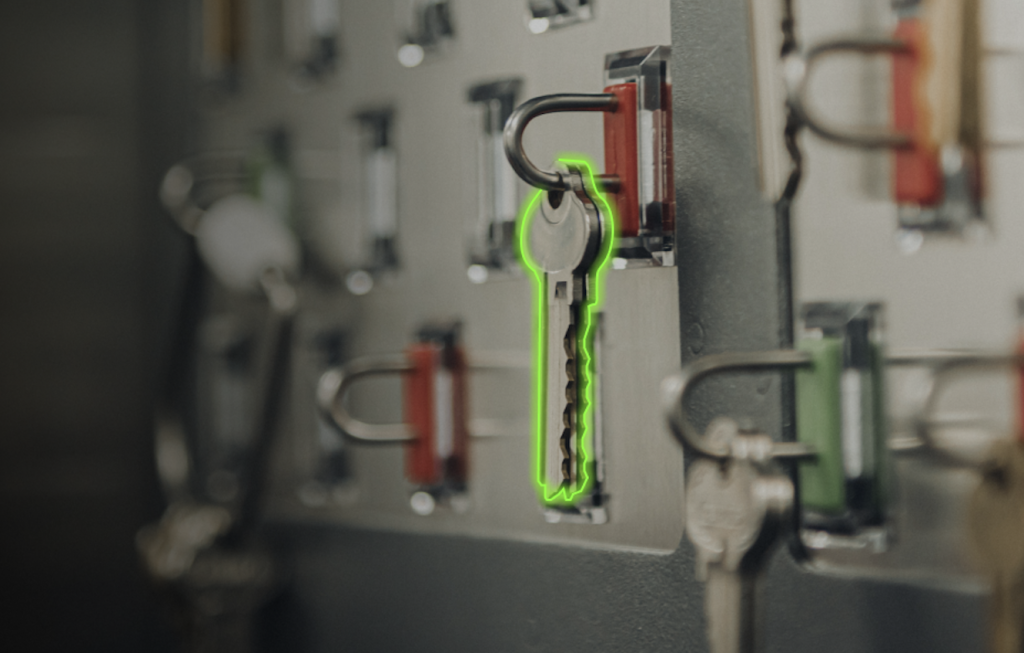
What is the difference between a key cabinet, a key safe and a manual key register?
The difference is what each one can prove. A key safe and a manual key register both depend on the person holding the key telling the truth, while an electronic key cabinet records the event itself, against a verified user, at the moment it happens.
A key safe is a small locked safe, opened by a shared combination, code or key, that holds one to a handful of keys. It controls who can open it but keeps no record of who did, or which key they took.
A manual key register is a paper logbook or spreadsheet where staff write down when they take and return a key. It holds whatever people chose to write after the fact, and it cannot confirm that any entry is accurate or complete.
An electronic key cabinet, sometimes called a digital key cabinet, is a networked cabinet that releases individual keys only to authorised users and logs every removal and return automatically. Nobody has to write anything down, and the cabinet can limit which keys each person may take and when.
Side-by-side comparison
The three options differ most on evidence: only an electronic key cabinet records who took which key without relying on someone to write it down. The rows below are the ones auditors and insurers tend to ask about.
| Criteria | Key safe | Manual key register | Electronic key cabinet |
| Typical capacity | Roughly 1 to 10 keys | No fixed limit | [[VERIFY CABINET CAPACITY RANGE]] |
| Who can take a key | Anyone with the combination or code | Anyone with access to the room where the keys hang | Only named, authorised users, and only the keys they are permitted to take |
| Record of who took what | None | Handwritten entry, made after the fact, on trust | Automatic, timestamped record of every removal and return |
| After-hours control | None | None, unless someone is present to supervise the book | Access restricted by time window, with alerts on overdue or out-of-hours access |
| Contractor and leaver access | Needs a manual code change or rekey when someone leaves | Relies on someone noticing a key is still signed out | Contractor credentials expire on schedule; leavers removed centrally |
| Reporting for an audit | Not possible | Reconstructed from paper at audit time | Exportable reports as CSV or PDF |
| Integration with access control or HR systems | None | None | Integrates with access control and HR platforms |
| Physical resistance | Varies widely by model and installation | Depends entirely on the room where the keys are kept | [[VERIFY: construction details and any security rating]] |
| Best fit | A handful of low-risk keys on a single site | Small teams with low-value keys and no audit obligation | Organisations that must prove who had which key |
When a key safe is enough
A key safe is enough when there are only a few keys, nothing they open is sensitive, and nobody is ever going to ask you to prove who used them. In that case, a key safe for business use is a reasonable choice.
It is a sound decision when:
- You hold a small number of keys, typically fewer than ten.
- None of them opens a high-risk area such as a server room, plant room, cash office or chemical store.
- The same small team uses them, and people rarely come and go.
- No auditor, insurer or client contract asks for records of key movements.
- Everything is on one site.
- The key safe sits inside a room that already has access control.
The weak point is the shared code. Once more than two or three people know the combination, the key safe gives you no evidence of who took what. If a key goes missing, the investigation is asking around, and the fix is a new code or a rekey.
Where a manual key register breaks down
A manual key register breaks down because it holds what people remembered to write, which is not always what happened. It works while the team is small and careful; add a night shift and a rotating list of contractors, and the gaps start to show.
Anyone who has reviewed one will recognise the failure modes:
- Pages that skip days or weeks, with no way to tell whether keys moved in between.
- Signatures without printed names, so an entry cannot be tied to a person.
- Blank return times, which leave it unclear whether a key came back at all.
- No after-hours record, because nobody supervises the book at night.
- Keys still signed out to people who left the organisation months ago.
Then there is “Dave from maintenance”. Every site seems to have one. Entries like this name a role, a first name or a company instead of a person, and when there are two Daves, or Dave was a subcontractor on a three-week job, the entry tells an investigator nothing.
A spreadsheet is easier to read, but it is still typed up after the fact and can be edited without a trace.
If a review is coming up, our key management system audit checklist is a quick way to test whether your register would hold up.
What an electronic key cabinet records that the others cannot
An electronic key cabinet records who took which key and when, for every removal and return, without anyone writing it down. Because the system creates that record as it happens, it stands up as evidence.
Each key is released only to a named, authorised user, who identifies themselves at the cabinet. Before releasing anything, the cabinet checks whether that person is allowed that key at that time. A shared code has no way to make that check.
Removals and returns are timestamped as they happen, so there are no blank return columns and no entries filled in from memory at the end of a shift.
The key management software shows which keys are in the cabinet, which are out and who has them. Finding the plant room key becomes a lookup rather than a ring-around.
The system can flag a key that is overdue, or one taken outside permitted hours, and notify a supervisor while there is time to act.
Key history can be exported as CSV or PDF when an auditor or insurer asks for it.
An electronic key cabinet can also share user and event data with systems the organisation already runs. With integrated key management, key permissions follow changes made in an access control or HR platform, so a leaver loses key access at the same moment as building access. KeyWatcher works with more than 40 integration partners.
For teams comparing electronic key cabinets in Australia, records and integration usually matter more than the hardware.

Which one fits your business? A quick decision guide
The right option comes down to how many keys you hold, who uses them, what they open, who checks and how many sites are involved. A yes to any of questions 2 to 5 below points to an electronic key cabinet.
- Are more than 20 keys in use? A key safe is no longer practical. You need a manual key register at minimum, and more likely an electronic key cabinet.
- Do contractors or casual staff work on site? Choose an electronic key cabinet, so access is granted per person and expires on schedule. Our guide to contractor key access management goes into this in more detail.
- Does any key open a high-risk area, such as a server room, plant room, cash office, chemical store or drug cabinet? Choose an electronic key cabinet.
- Are audits, insurers or WHS obligations in play? Choose an electronic key cabinet. It is the only one of the three that produces a record nobody has to reconstruct.
- Do you have multiple sites with one owner of key control? Choose an electronic key cabinet with central software, so every site reports into one view.
Some readers will work through these and legitimately conclude that a key safe is fine for now. If every answer was no, that is a reasonable call, and one worth revisiting when the team grows or the risk changes.
Any honest key control system comparison has to include cost. What drives the cost of an electronic key cabinet is the number of keys and sites, the credential type and how much integration you need. Weigh that against rekeying, call-outs and staff time after a key goes missing, which is the real cost of a lost key walk-through.
If your register cannot tell you who had a specific key last Tuesday, the comparison has probably answered itself for you. To see how an electronic key cabinet would work on your sites, request a demonstration, or use the Price and Build configurator to put together an indicative configuration for the budget conversation.
Frequently asked questions
Short answers to the questions facilities and security teams raise most when comparing the three options.
What is the difference between a key safe and a key cabinet?
A key safe stores a few keys behind a shared code and records nothing about who uses them. An electronic key cabinet releases each key only to an authorised, named user and logs every removal and return automatically. In the key cabinet vs key safe question, the practical difference is evidence: only the cabinet can show who had a key and when.
How many keys do you need before a key management system is worth it?
There is no fixed number, because risk and the number of people sharing keys matter more than the count. As a working rule, once more than 20 keys are in use, or more than two or three people share access to sensitive keys, a manual approach starts to lose track. Contractors, high-risk areas and audit requirements bring that point forward.
Is a manual key register acceptable for WHS compliance in Australia?
Australian WHS and Victorian OHS laws do not specifically mandate a key management audit, but they do require managing risks so far as is reasonably practicable, and key control is part of that. A manual key register can play a part in managing that risk, but it is only as good as the way it is kept. Where keys open high-risk areas, gaps in a handwritten record are difficult to explain to an auditor or insurer.
Can a key safe be integrated with access control?
A standard key safe cannot, because it holds no record of users or events to share. Integration with access control and HR systems is a feature of electronic key cabinets, which identify each user and log each transaction. That is how key permissions can change automatically when someone’s role or employment changes.
What happens to contractor access when an engagement ends?
With an electronic key cabinet, contractor credentials can be set to expire on the last day of the engagement, so access stops without anyone needing to remember. With a key safe, the code has to be changed and the new one shared with everyone else; with a manual key register, someone has to notice the key is still signed out. Any key that does not come back may mean rekeying the lock.